No products
Prices are tax excluded
New products
-

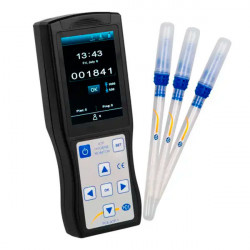
ATP Hygiene Monitoring Meter for Surface Cleaning Verification and HACCP - PCE-ATP 1
The PCE-ATP 1 from PCE Instruments is a portable ATP luminometer...
1 399,90€ -

Waterproof Dissolved Oxygen Meter for Water Analysis - Senseca ECO 531
Dissolved oxygen measurement is an important parameter in water quality...
349,60€ -

Compact Conductivity Meter for Hydroponics, Aquaculture and Water Treatment - Senseca ECO 521
Daily water and nutrient checks need a meter that is quick to use, easy...
191,40€ -

Soil and Compost Thermometer with Pt1000 Probe - Senseca ECO 120-SoilTemp-1000
Core temperature checks in soil, compost and stored bulk goods require a...
261,60€ -

Digital Temperature and Humidity Probe for PRO Handheld Meters - Senseca DX 31X
Accurate humidity and temperature checks start with a probe the meter...
217,40€ -

Temperature and Humidity Data Logger with Built-In Sensors - COMET U3120
The COMET U3120 is a compact data logger designed to continuously record...
240,00€ -

5-Port Unmanaged Industrial Ethernet Switch - NS-205A CR
The NS-205A CR is a compact 5-port unmanaged Ethernet switch designed to...
75,00€ -

Soil and Compost Thermometer with Pt1000 Probe - Senseca ECO 120-SoilTemp-620
Core temperature checks in soil, compost and stored bulk goods require a...
239,80€ -

Pressure Transmitter with Stainless Steel Membrane 4 – 20 mA - Senseca EPS2
The Senseca EPS2 is a pressure transmitter designed for applications...
-

Digital Refractometer for Industrial & Automotive Applications - KERN ORL 94IN
The KERN ORL 94IN is a precise, versatile digital benchtop refractometer...
990,00€ -

Digital Refractometer for Glycol and Brix - KERN ORM 2CA
The KERN ORM 2CA is a precise and versatile portable digital...
375,00€ -

Digital Soil Moisture and Temperature Probe - Senseca DX 721
The Senseca DX 721 is a state-of-the-art digital probe designed to...
274,80€ -

Multifunction Data Logger for DX Digital Probes - Senseca PRO D05.2
The Senseca PRO D05.2 is a professional handheld multifunction meter and...
372,60€ -

Câmara de Imagem Acústica para Smartphone - FOTRIC TD2eGeek
The FOTRIC TD2eGeek is a compact acoustic imager designed to be used...
678,00€ -

Single-Channel Ni1000 / Pt1000 Thermometer with Data Logger D0211
The COMET D0211 is a single-channel precision thermometer designed for...
225,00€ -

Isolated RS-232 to RS-485 Converter I-7520 CR
The ICP DAS I-7520 CR is an industrial converter designed to convert...
70,00€ -

Professional Surface Roughness Measurement Elcometer 7062 MarSurf PS10
Professional Surface Roughness Measurement In protective coatings...
3 140,00€ -

Advanced Acoustic Imaging for Industrial Inspection FOTRIC TD2e Kit
FOTRIC TD2e Kit The FOTRIC TD2e Kit is a professional acoustic imaging...
849,00€ -

Display para Salas Limpas, Blocos Operatórios e Laboratórios PEDAKP7
PEDAKP7 Display The Pedak Display is an advanced solution for real-time...
985,00€ -

Professional Monitoring System Perseus Monitoring 150
Professional Monitoring for 19" Racks, Server Rooms and Data Centres The...
698,90€ -

Water Leak Detection Sensing Cable - WLD-Sensing Cable A
Water leak detection along the entire protected area The HW group...
127,50€ -

DIN Rail Industrial Monitoring and Control - Perseus Industrial 310
The Perseus Industrial 310 is a LAN monitoring unit designed for...
587,70€ -

LAN/LTE Remote Monitoring Starter Set - Perseus Monitoring 145 Tset
The Perseus Monitoring 145 is designed for professional remote site...
781,60€ -

Modbus RTU to TCP Ethernet Gateway - Perseus Energy 240
Industrial Ethernet Gateway for Advanced Monitoring The Perseus Energy...
327,50€ -

Sensor for One Digital Temperature and Humidity or CO2 Probe with Ethernet and PoE TA361
The TA3611 is a flexible Ethernet sensor designed to connect one...
330,00€ -

Ultrasonic Flow Meter with 32 GB Memory PCE-TDS 200 S
The PCE-TDS 200 S is a portable ultrasonic flow meter designed to...
2 249,00€ -

Anemometer with 4-20 mA Analog Output PCE-WS-A
The PCE-WS A is a professional anemometer designed for applications...
199,90€ -

Fruit Firmness Tester for Blueberries, Raspberrys, Grapes and Strawberries
The BAXLO 53505/F0 fruit firmness tester is designed to measure the...
493,03€ -

Ultrasonic Sensors for DN 50 ... 700 PCE-TDS 200 M SENSOR
The PCE-TDS 200 M SENSOR is an ultrasonic sensor set developed for...
359,90€ -

Ultrasonic Flow Meter with Thermal Energy Measurement PCE-TDS 200 Plus S
The PCE-TDS 200+ S is a portable ultrasonic flow meter designed to...
3 269,90€ -

Ethernet data logger for continuous temperature and humidity monitoring TCW210-TH
The TCW210-TH is a professional temperature and humidity data logger for...
141,60€ -

Ultraviolet radiation measurement with external sensor PCE-UV34
The PCE-UV34 is a professional UV meter designed for precise ultraviolet...
229,90€ -

Analogue Thermo-Hygrometer 45.2041
The 45.2041 analogue thermo-hygrometer is a practical and elegant...
11,40€ -

Remote IO Module with SNMP v1 for Monitoring and Control
The TCW122B-CM is a remote IO module designed for environmental...
87,80€ -

Waterproof Temperature Data Logger TG-4105
The Tinytag Splash 2 TG-4105 is a waterproof high temperature data...
225,00€ -

Ultrasonic Hardness Tester PCE-5000
The PCE-5000 is a professional ultrasonic hardness tester for metals...
5 906,90€ -

Moisture Meter for Building Materials PCE-PMI 4
PCE-PMI 4 Moisture Meter for Building Materials The PCE-PMI 4 is a...
499,90€ -

Display para Salas Limpas, Blocos Operatórios e Laboratórios PEDAKP5
PEDAKP5 Display The Pedak Display is an advanced solution for real-time...
845,00€ -

Professional Breathalyzer Certified EN 15964 Zaphir AT-4000
Professional Breathalyzer The Zaphir AT-4000 is a professional portable...
199,00€ -

Ultrasonic Thickness Gauge PCE-CT 1000
For Multilayer Measurement and Coating Inspection The PCE-CT 1000...
1 849,90€ -

Ultrasonic Thickness Gauge PCE-TG 300-NO7
Ultrasonic Thickness Gauge The PCE-TG 300-NO7 is a professional...
1 109,90€ -

Digital Force Gauge 200 N Tension and Compression Testing with USB
Digital Force Gauge | 200 N Tension and Compression Testing with USB The...
359,90€ -

USB Temperature Data Logger with LCD Screen EL-USB-1-LCD
EasyLog EL-USB-1-LCD | USB Temperature Data Logger with LCD Screen The...
75,00€ -

PCE-3500 UCI Hardness Tester for Non-Destructive Metal Testing PCE-3500
UCI Hardness Tester The PCE-3500 hardness tester is a professional...
3 789,90€ -

Termómetro Infravermelho com Bluetooth e Sonda de Inserção
Infrared Thermometer & Penetration Probe With integrated Bluetooth...
119,90€ -

Infrared thermometer with USB interfac PCE-890U
Infrared thermometer with USB interface for real-time data monitoring...
294,90€ -

Infrared Thermometer with Data Logger and Printer – PCE-JR 911
Infrared Thermometer with Printer The PCE-JR 911 is a professional...
479,90€ -

Bluetooth Barcode Scanning Thermometer MM7000-2D
MM7000-2D – Bluetooth Barcode Scanning Thermometer The MM7000-2D...
413,68€ -

Fish fillet salinity meter PAL-Fish Fillets 4225
Fish Fillet Salinity Meter – PAL-Fish Fillets The PAL-Fish Fillets (Ref....
547,00€ -

Professional Moisture Meter for Wood and Building Materials PCE-WP24
Detect moisture without damage. Work with professional confidence. The...
726,90€ -

Pressure Transmitter with Ceramic Membrane 4 – 20 mA - Senseca EPS1
The Senseca EPS1 is an industrial pressure transmitter designed for...
-

Coating Thickness Gauge – Separate Probe Model Elcometer A456CFSS
Elcometer 456 Coating Thickness Gauge – Separate Probe ModelThe...
531,00€

EMI, LDA, Edifício Estoril Office, Av. República 3000A, Esc. 19A, 2649-517 Alcabideche PORTUGAL
Hygiene and Cleaning Control
Turn cleaning procedures into measurable results with professional equipment for surface hygiene monitoring, ATP bioluminescence testing, cleaning effectiveness verification and HACCP...
Hygiene and Cleaning Control
Turn cleaning procedures into measurable results with professional equipment for surface hygiene monitoring, ATP bioluminescence testing, cleaning effectiveness verification and HACCP programmes.
EMI – Electronic Measuring Instruments provides measurement solutions for quality assurance, food safety, industrial hygiene, healthcare and professional cleaning specialists.
Professional Surface Hygiene Monitoring
Verification of cleaning effectiveness is an important element of cross-contamination prevention, food safety management and process quality control.
Visually clean surfaces may still contain food residues and other biological material. Professional measurement instruments complement visual inspection with quantitative hygiene indicators.
Hygiene monitoring solutions help quality managers assess cleaning procedures, identify deviations, implement corrective actions and document inspection results.
Complement visual inspection with measurement technologies and hygiene tests that help assess residual contamination, improve cleaning procedures and support operational decisions.
Hygiene Monitoring Equipment and Solutions
01 – ATP Meters and Luminometers
Portable instruments using ATP bioluminescence technology to rapidly assess residual biological material on surfaces, equipment and utensils.
• Portable ATP meters
• Professional luminometers
• Relative Light Unit (RLU) measurements
• Instruments with memory and analysis software
• Equipment for hygiene verification programmes
02 – ATP Swabs and Consumables
Consumables for surface sampling and bioluminescence testing with compatible ATP luminometers.
• ATP test swabs
• Reagent test tubes
• Surface sampling consumables
• Hygiene monitoring system accessories
03 – Surface Hygiene Testing
Methods and instruments for complementary assessment of cleanliness on food-contact surfaces, worktops, production lines and working areas.
• Residue checks after cleaning
• Food preparation surface assessment
• Comparison of results before and after cleaning
• Support for cleaning programme verification
04 – Microbiological Testing
Specific microbiological testing methods and equipment to complement hygiene monitoring programmes, according to application requirements.
Microbiological analysis and ATP testing use different principles and perform complementary functions. Method selection should consider the analytical objectives and applicable technical requirements.
What Is ATP Bioluminescence Technology?
ATP (adenosine triphosphate) is a molecule associated with living cells and may be present in food residues and other materials of biological origin.
ATP testing uses a biochemical reaction that generates light. The intensity of the light signal is measured by a luminometer and expressed in Relative Light Units (RLU).
This technology provides a rapid quantitative hygiene indicator, helping identify surfaces that may require additional cleaning or further assessment.
How Does ATP Hygiene Testing Work?
Collect a sample from the surface using a compatible test swab, following the established sampling procedure.
Prepare the bioluminescence reaction according to the consumable manufacturer's instructions.
Insert the test tube into the luminometer and initiate the measurement.
Compare the RLU reading with the acceptance limits established and validated for the application.
Record the result and implement corrective action when required, including additional cleaning and repeat testing.
Interpretation of Hygiene Test Results
ATP test results can be integrated into an organisation-specific hygiene classification system.
Result within the established acceptance limits.
Result within a warning range that may require further assessment.
Result exceeding the established limits and requiring corrective action.
Illustrative operational classification. Universal RLU acceptance limits cannot be applied to all instruments, surfaces and sampling methods.
Hygiene Monitoring, Food Safety and HACCP
Cleaning verification can form part of hygiene prerequisite programmes associated with HACCP systems, supporting more systematic monitoring of food safety procedures.
• Hygiene verification before production starts.
• Assessment of cleaning effectiveness.
• Support for cross-contamination prevention.
• Identification of surfaces requiring additional cleaning.
• Monitoring of cleaning and hygiene programmes.
• Documentation of results and corrective actions.
• Support for audits and inspection preparation.
Industries and Applications
| Industry | Applications |
|---|---|
| Food and beverage industry | Production lines, equipment, utensils and food-contact surfaces. |
| Hospitality and restaurants | Commercial kitchens, worktops and food preparation areas. |
| Hospitals and clinics | Complementary cleaning assessment of surfaces and frequently touched areas. |
| Pharmaceutical industry and pharmacies | Complementary hygiene verification of working areas according to applicable protocols. |
| Supermarkets and food retail | Counters, display cabinets and food preparation areas. |
| Catering and institutional food services | Industrial kitchens, school and hospital catering facilities. |
| Laboratories | Support for cleaning verification of worktops and working surfaces. |
| Professional cleaning services | Assessment and documentation of cleaning service results. |
Featured Instrument – PCE-ATP 1
PCE Instruments PCE-ATP 1 – Portable ATP Luminometer
Professional instrument for rapid surface hygiene verification using ATP bioluminescence technology.
• Results in just 10 seconds after measurement starts.
• Measuring range from 0 to 999999 RLU.
• Resolution of 1 RLU.
• Memory for 10,000 readings with date and time.
• Automatic calibration at every start-up.
• USB and Bluetooth interfaces.
• Analysis software included.
• Compatible PCE-ATP Swap consumables, ordered separately.
Benefits for Your Organisation
• Rapid results supporting hygiene decisions.
• Improved control of cleaning procedures.
• Objective assessment of cleaning service performance.
• Identification of corrective action requirements.
• Improved traceability of hygiene checks.
• Continuous improvement of hygiene programmes.
• Support for food safety and HACCP systems.
• Documentation for quality audits.
Frequently Asked Questions About Hygiene and Cleaning Control
An ATP meter uses bioluminescence to assess residual biological material, supporting surface hygiene verification.
The measurement time depends on the instrument. The PCE-ATP 1 displays results in 10 seconds after measurement starts.
RLU stands for Relative Light Units and represents the intensity of the light signal generated during the bioluminescence reaction.
Yes. ATP testing can be used as a complementary tool for cleaning verification and hygiene prerequisite programmes.
No. ATP testing does not identify specific microorganisms, directly determine bacterial counts or demonstrate surface sterility.
Yes. ATP testing requires swabs and reagents compatible with the luminometer being used.
Acceptance limits should be established and validated according to the instrument, sampling method, surface type and application-specific risks.
Hygiene monitoring instruments support cleaning and food safety procedures. They do not replace applicable microbiological analyses, disinfection procedure validation or industry-specific regulatory requirements.
Strengthen your hygiene programmes with professional measurement solutions, ATP technologies, portable instruments and consumables for cleaning effectiveness verification.
Contact our team for technical and commercial assistance in selecting the most suitable solution for your organisation.
Hygiene and Cleaning Control There is 1 product.
ATP Hygiene Monitoring Meter for Surface...
The PCE-ATP 1 from PCE Instruments is a portable ATP luminometer designed for rapid surface hygiene verification and assessment of cleaning effectiveness, delivering results in just 10 seconds.
1 399,90€