No products
Prices are tax excluded
New products
-

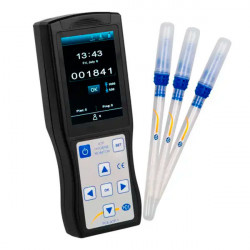
ATP Hygiene Monitoring Meter for Surface Cleaning Verification and HACCP - PCE-ATP 1
The PCE-ATP 1 from PCE Instruments is a portable ATP luminometer...
1 399,90€ -

Waterproof Dissolved Oxygen Meter for Water Analysis - Senseca ECO 531
Dissolved oxygen measurement is an important parameter in water quality...
349,60€ -

Compact Conductivity Meter for Hydroponics, Aquaculture and Water Treatment - Senseca ECO 521
Daily water and nutrient checks need a meter that is quick to use, easy...
191,40€ -

Soil and Compost Thermometer with Pt1000 Probe - Senseca ECO 120-SoilTemp-1000
Core temperature checks in soil, compost and stored bulk goods require a...
261,60€ -

Digital Temperature and Humidity Probe for PRO Handheld Meters - Senseca DX 31X
Accurate humidity and temperature checks start with a probe the meter...
217,40€ -

Temperature and Humidity Data Logger with Built-In Sensors - COMET U3120
The COMET U3120 is a compact data logger designed to continuously record...
240,00€ -

5-Port Unmanaged Industrial Ethernet Switch - NS-205A CR
The NS-205A CR is a compact 5-port unmanaged Ethernet switch designed to...
75,00€ -

Soil and Compost Thermometer with Pt1000 Probe - Senseca ECO 120-SoilTemp-620
Core temperature checks in soil, compost and stored bulk goods require a...
239,80€ -

Pressure Transmitter with Stainless Steel Membrane 4 – 20 mA - Senseca EPS2
The Senseca EPS2 is a pressure transmitter designed for applications...
-

Digital Refractometer for Industrial & Automotive Applications - KERN ORL 94IN
The KERN ORL 94IN is a precise, versatile digital benchtop refractometer...
990,00€ -

Digital Refractometer for Glycol and Brix - KERN ORM 2CA
The KERN ORM 2CA is a precise and versatile portable digital...
375,00€ -

Digital Soil Moisture and Temperature Probe - Senseca DX 721
The Senseca DX 721 is a state-of-the-art digital probe designed to...
274,80€ -

Multifunction Data Logger for DX Digital Probes - Senseca PRO D05.2
The Senseca PRO D05.2 is a professional handheld multifunction meter and...
372,60€ -

Câmara de Imagem Acústica para Smartphone - FOTRIC TD2eGeek
The FOTRIC TD2eGeek is a compact acoustic imager designed to be used...
678,00€ -

Single-Channel Ni1000 / Pt1000 Thermometer with Data Logger D0211
The COMET D0211 is a single-channel precision thermometer designed for...
225,00€ -

Isolated RS-232 to RS-485 Converter I-7520 CR
The ICP DAS I-7520 CR is an industrial converter designed to convert...
70,00€ -

Professional Surface Roughness Measurement Elcometer 7062 MarSurf PS10
Professional Surface Roughness Measurement In protective coatings...
3 140,00€ -

Advanced Acoustic Imaging for Industrial Inspection FOTRIC TD2e Kit
FOTRIC TD2e Kit The FOTRIC TD2e Kit is a professional acoustic imaging...
849,00€ -

Display para Salas Limpas, Blocos Operatórios e Laboratórios PEDAKP7
PEDAKP7 Display The Pedak Display is an advanced solution for real-time...
985,00€ -

Professional Monitoring System Perseus Monitoring 150
Professional Monitoring for 19" Racks, Server Rooms and Data Centres The...
698,90€ -

Water Leak Detection Sensing Cable - WLD-Sensing Cable A
Water leak detection along the entire protected area The HW group...
127,50€ -

DIN Rail Industrial Monitoring and Control - Perseus Industrial 310
The Perseus Industrial 310 is a LAN monitoring unit designed for...
587,70€ -

LAN/LTE Remote Monitoring Starter Set - Perseus Monitoring 145 Tset
The Perseus Monitoring 145 is designed for professional remote site...
781,60€ -

Modbus RTU to TCP Ethernet Gateway - Perseus Energy 240
Industrial Ethernet Gateway for Advanced Monitoring The Perseus Energy...
327,50€ -

Sensor for One Digital Temperature and Humidity or CO2 Probe with Ethernet and PoE TA361
The TA3611 is a flexible Ethernet sensor designed to connect one...
330,00€ -

Ultrasonic Flow Meter with 32 GB Memory PCE-TDS 200 S
The PCE-TDS 200 S is a portable ultrasonic flow meter designed to...
2 249,00€ -

Anemometer with 4-20 mA Analog Output PCE-WS-A
The PCE-WS A is a professional anemometer designed for applications...
199,90€ -

Fruit Firmness Tester for Blueberries, Raspberrys, Grapes and Strawberries
The BAXLO 53505/F0 fruit firmness tester is designed to measure the...
493,03€ -

Ultrasonic Sensors for DN 50 ... 700 PCE-TDS 200 M SENSOR
The PCE-TDS 200 M SENSOR is an ultrasonic sensor set developed for...
359,90€ -

Ultrasonic Flow Meter with Thermal Energy Measurement PCE-TDS 200 Plus S
The PCE-TDS 200+ S is a portable ultrasonic flow meter designed to...
3 269,90€ -

Ethernet data logger for continuous temperature and humidity monitoring TCW210-TH
The TCW210-TH is a professional temperature and humidity data logger for...
141,60€ -

Ultraviolet radiation measurement with external sensor PCE-UV34
The PCE-UV34 is a professional UV meter designed for precise ultraviolet...
229,90€ -

Analogue Thermo-Hygrometer 45.2041
The 45.2041 analogue thermo-hygrometer is a practical and elegant...
11,40€ -

Remote IO Module with SNMP v1 for Monitoring and Control
The TCW122B-CM is a remote IO module designed for environmental...
87,80€ -

Waterproof Temperature Data Logger TG-4105
The Tinytag Splash 2 TG-4105 is a waterproof high temperature data...
225,00€ -

Ultrasonic Hardness Tester PCE-5000
The PCE-5000 is a professional ultrasonic hardness tester for metals...
5 906,90€ -

Moisture Meter for Building Materials PCE-PMI 4
PCE-PMI 4 Moisture Meter for Building Materials The PCE-PMI 4 is a...
499,90€ -

Display para Salas Limpas, Blocos Operatórios e Laboratórios PEDAKP5
PEDAKP5 Display The Pedak Display is an advanced solution for real-time...
845,00€ -

Professional Breathalyzer Certified EN 15964 Zaphir AT-4000
Professional Breathalyzer The Zaphir AT-4000 is a professional portable...
199,00€ -

Ultrasonic Thickness Gauge PCE-CT 1000
For Multilayer Measurement and Coating Inspection The PCE-CT 1000...
1 849,90€ -

Ultrasonic Thickness Gauge PCE-TG 300-NO7
Ultrasonic Thickness Gauge The PCE-TG 300-NO7 is a professional...
1 109,90€ -

Digital Force Gauge 200 N Tension and Compression Testing with USB
Digital Force Gauge | 200 N Tension and Compression Testing with USB The...
359,90€ -

USB Temperature Data Logger with LCD Screen EL-USB-1-LCD
EasyLog EL-USB-1-LCD | USB Temperature Data Logger with LCD Screen The...
75,00€ -

PCE-3500 UCI Hardness Tester for Non-Destructive Metal Testing PCE-3500
UCI Hardness Tester The PCE-3500 hardness tester is a professional...
3 789,90€ -

Termómetro Infravermelho com Bluetooth e Sonda de Inserção
Infrared Thermometer & Penetration Probe With integrated Bluetooth...
119,90€ -

Infrared thermometer with USB interfac PCE-890U
Infrared thermometer with USB interface for real-time data monitoring...
294,90€ -

Infrared Thermometer with Data Logger and Printer – PCE-JR 911
Infrared Thermometer with Printer The PCE-JR 911 is a professional...
479,90€ -

Bluetooth Barcode Scanning Thermometer MM7000-2D
MM7000-2D – Bluetooth Barcode Scanning Thermometer The MM7000-2D...
413,68€ -

Fish fillet salinity meter PAL-Fish Fillets 4225
Fish Fillet Salinity Meter – PAL-Fish Fillets The PAL-Fish Fillets (Ref....
547,00€ -

Professional Moisture Meter for Wood and Building Materials PCE-WP24
Detect moisture without damage. Work with professional confidence. The...
726,90€ -

Pressure Transmitter with Ceramic Membrane 4 – 20 mA - Senseca EPS1
The Senseca EPS1 is an industrial pressure transmitter designed for...
-

Coating Thickness Gauge – Separate Probe Model Elcometer A456CFSS
Elcometer 456 Coating Thickness Gauge – Separate Probe ModelThe...
531,00€

EMI, LDA, Edifício Estoril Office, Av. República 3000A, Esc. 19A, 2649-517 Alcabideche PORTUGAL
ATP Meters and Luminometers
Turn hygiene procedures into measurable results with professional ATP meters and luminometers, designed for rapid assessment of residual biological material on sur...
ATP Meters and Luminometers
Turn hygiene procedures into measurable results with professional ATP meters and luminometers, designed for rapid assessment of residual biological material on surfaces, equipment and utensils using ATP bioluminescence technology.
EMI – Electronic Measuring Instruments provides professional solutions for hygiene monitoring, food safety, HACCP programmes, quality control and cleaning verification.
ATP Meters for Professional Hygiene Monitoring
ATP meters, also known as ATP luminometers, are instruments used to rapidly assess residual biological material on surfaces, complementing visual inspection with quantitative results.
These instruments help quality and food safety professionals assess cleaning effectiveness, identify surfaces that may require additional cleaning and document hygiene inspection results.
Unlike conventional microbiological methods that may require incubation periods, ATP technology provides a rapid hygiene indicator, supporting operational decisions. These methods have different and complementary purposes.
Visually clean surfaces may still contain food residues and biological material. ATP luminometers provide quantitative information within seconds, supporting decisions on additional cleaning or further assessment.
What Is an ATP Luminometer and How Does It Work?
ATP – adenosine triphosphate – is a molecule associated with living cells and may be present in food residues, microbial cells and other biological materials.
ATP bioluminescence technology uses a biochemical reaction involving luciferin and luciferase, generating a light signal associated with the amount of ATP present in the sample.
The luminometer measures the intensity of the light signal and displays the result in Relative Light Units (RLU).
Under equivalent testing conditions, higher RLU readings may indicate a greater amount of detected ATP. Results should be interpreted according to acceptance limits established and validated for the instrument, surface and sampling method.
How to Perform an ATP Hygiene Test
Collect a surface sample using a compatible ATP swab, following the established sampling area and procedure.
Prepare the bioluminescence reaction according to the consumable manufacturer's instructions.
Insert the test tube into the measuring chamber and initiate the analysis.
Compare the RLU reading with the acceptance criteria established for the sampling location.
Record the result and, when necessary, repeat the cleaning procedure and perform another hygiene test.
ATP Instrumentation and Luminometry Solutions
Portable ATP Luminometers
Compact instruments for rapid on-site hygiene verification in production, preparation, storage and equipment operation areas.
ATP Meters with Internal Memory
Instruments capable of storing measurement results, supporting historical hygiene performance assessment and documentation of cleaning procedures.
ATP Systems with Digital Connectivity
Solutions featuring communication interfaces and analysis software, depending on the model, for transferring results and managing hygiene measurement data.
Featured Instrument – PCE-ATP 1
PCE-ATP 1 – Portable ATP Hygiene Luminometer
The PCE-ATP 1 from PCE Instruments combines rapid measurement, internal memory, digital connectivity and straightforward operation in a portable solution for cleaning effectiveness verification.
| Feature | PCE-ATP 1 |
|---|---|
| Measuring range | 0...999999 RLU |
| Resolution | 1 RLU |
| Measurement time | 10 seconds |
| Memory | 10,000 readings with date and time |
| Display | 3.5" graphical LCD |
| Connectivity | USB and Bluetooth |
| Internal calibration | Automatic at every start-up |
| Analysis software | Included |
| Continuous battery life | 10 hours |
| Compatible consumables | PCE-ATP Swap |
Test swabs and reagents required for measurements are consumables to be ordered separately.
Interpretation of ATP Test Results
ATP test results can be integrated into an operational hygiene classification system established and validated by the organisation.
Result within the established acceptance criteria.
Result within a warning range that may require further assessment.
Result requiring corrective action according to the hygiene monitoring plan.
Illustrative classification only. Universal RLU acceptance limits cannot be applied to all luminometers, surfaces and sampling procedures.
ATP Testing versus Microbiological Analysis
| Parameter | ATP Testing | Microbiological Analysis |
|---|---|---|
| Principle | Bioluminescence | Culture or other specific methods |
| Result | RLU | CFU, presence/absence or other indicators |
| Measurement time | Seconds, depending on the model | Method-dependent; often hours or days |
| Microorganism identification | No | Possible with specific methods |
| Application | Rapid hygiene verification | Specific microbiological assessment |
ATP testing and microbiological analysis are complementary tools. ATP luminometry cannot identify specific pathogens, directly determine viable microorganism counts or demonstrate surface sterility.
ATP Luminometers for Food Safety and HACCP
ATP technology can be integrated into hygiene prerequisite programmes associated with HACCP systems, supporting cleaning verification and continuous improvement of food safety procedures.
• Hygiene verification before production starts.
• Assessment of cleaning effectiveness.
• Support for cross-contamination prevention.
• Identification of surfaces requiring additional cleaning.
• Comparison of readings before and after cleaning.
• Documentation of hygiene checks and corrective actions.
• Support for quality and food safety audits.
Industries and Applications
Production lines, equipment, conveyors, utensils and food-contact surfaces.
Commercial kitchens, worktops, cutting boards, utensils and food preparation areas.
Complementary cleaning verification of surfaces and frequently touched areas.
Complementary hygiene assessment of worktops and working areas according to applicable protocols.
Hygiene monitoring of counters, display equipment and food preparation areas.
Complementary assessment of cleaning effectiveness on working surfaces.
Quantitative assessment and documentation of cleaning service results.
Support for the implementation, monitoring and verification of hygiene programmes.
Benefits of ATP Meters and Luminometers
• Rapid results supporting operational decisions.
• Quantitative assessment of hygiene levels.
• Straightforward operation for routine hygiene checks.
• Rapid identification of additional cleaning requirements.
• Support for continuous improvement of cleaning procedures.
• Improved documentation of hygiene checks.
• Support for food safety and HACCP programmes.
• Potential integration of results into quality management processes.
How to Choose an ATP Meter
Selecting an ATP luminometer requires consideration of application-specific requirements and the costs associated with regular instrument operation.
• Measuring range, resolution and analytical performance.
• Measurement time.
• Expected number of daily or monthly tests.
• Memory capacity and result management.
• Software and communication interfaces.
• Consumable availability, shelf life and cost.
• Reagent storage requirements.
• Technical support and long-term operating costs.
ATP Swabs, Reagents and Consumables
ATP luminometers require compatible swabs, reagents or other consumables for hygiene testing.
Consumable compatibility must be confirmed for each instrument model. Manufacturer-specified storage conditions and expiry dates must also be observed.
Frequently Asked Questions About ATP Meters and Luminometers
An ATP meter provides rapid assessment of residual biological material, supporting surface cleaning effectiveness verification.
In the context of ATP bioluminescence hygiene testing, both terms refer to instruments that measure the light signal generated during the ATP-associated reaction.
Measurement time depends on the instrument and procedure. The PCE-ATP 1 provides results in 10 seconds after measurement starts.
No. ATP testing provides an indirect indication of biological residues but cannot identify specific microorganisms or directly determine bacterial counts.
Acceptance limits should be established and validated for each application, considering the instrument, surface, consumables and sampling procedure.
Yes. ATP luminometers provide a complementary tool for cleaning verification and hygiene prerequisite programmes.
Not necessarily. Consumables must be selected according to their confirmed compatibility with the luminometer being used.
EMI provides ATP luminometry solutions and associated consumables, with technical and commercial assistance in selecting suitable instruments for your application.
ATP meters are complementary hygiene verification tools. They do not replace microbiological analysis, specific allergen testing, disinfection procedure validation or other controls required by the application.
Improve your hygiene monitoring procedures with professional ATP meters, portable luminometers and specialised consumables for food safety and quality control.
Contact our team for a personalised proposal tailored to your organisation, taking into account the number of tests, sampling locations and documentation requirements.
ATP Meters and Luminometers There is 1 product.
ATP Hygiene Monitoring Meter for Surface...
The PCE-ATP 1 from PCE Instruments is a portable ATP luminometer designed for rapid surface hygiene verification and assessment of cleaning effectiveness, delivering results in just 10 seconds.
1 399,90€